( White-label web development )
White-label web development for agencies and design studios
Lychee is an independent creative development studio in Auckland. Studios and agencies bring us in when a design needs more than a standard build, and when the finished work has to ship under their name and not ours.
We build the frontend, the motion and the WebGL. You keep the client relationship, the brand on the invoice and the credit at the end of it.
( The arrangement )
What white-label means here
You are the studio
The work is delivered to you, and you deliver it onward. Nothing carries our mark unless you decide it should: no badge in the footer, no link back, no post about it while the project is live.
Credit is a choice you make, not a condition of the work. Fully white-label, named as a collaborator, or left open until the project is finished — all three are normal, and we ask before we assume.
Your client stays your client
We do not approach the people you introduce us to — not during the project and not after it. If you want a non-solicitation clause or an NDA in writing, send it through with the brief.
Communication runs through you by default. Where it is genuinely faster for us to sit in a client call or your Slack, we will, as part of your team and under your name.
( The work itself )
What we actually build
Creative development
Taking a strong visual direction into the browser without losing what made it interesting. Layout, typography, motion and interaction considered together, never bolted on in sequence.
Interactive and 3D
Three.js and WebGL when the idea needs more than a flat page — from small moments of depth through to a fully interactive scene, built to a frame budget and not to a demo.
Three.js and WebGL workFrontend production
The quieter half: responsive builds, content systems the client can actually use, accessibility, and code that reads well to whoever inherits it. Whole site, or fitted into an existing team and codebase.
( Before we start )
What a good handover contains
Almost every difficult build we have seen went difficult at the handover, not in the code. Four things make the difference.
- The design, as final as it gets
- Figma or equivalent, with the states that matter drawn — hover, empty, error, mobile. Where it is still moving, tell us which parts are settled and which are not.
- The motion intent
- A reference, a rough animation, or a paragraph describing what should move and why. We would rather have a scrappy reference than guess at the feel.
- The content state
- Real copy, placeholder copy, or the rules for both. We shape structure, headlines and key wording from what you give us — full copywriting is scoped separately.
- The constraints
- The stack you need, the CMS the client already pays for, the browsers and devices you support, the date it has to be live, and who signs off.
( The standard )
The frontend we hand over
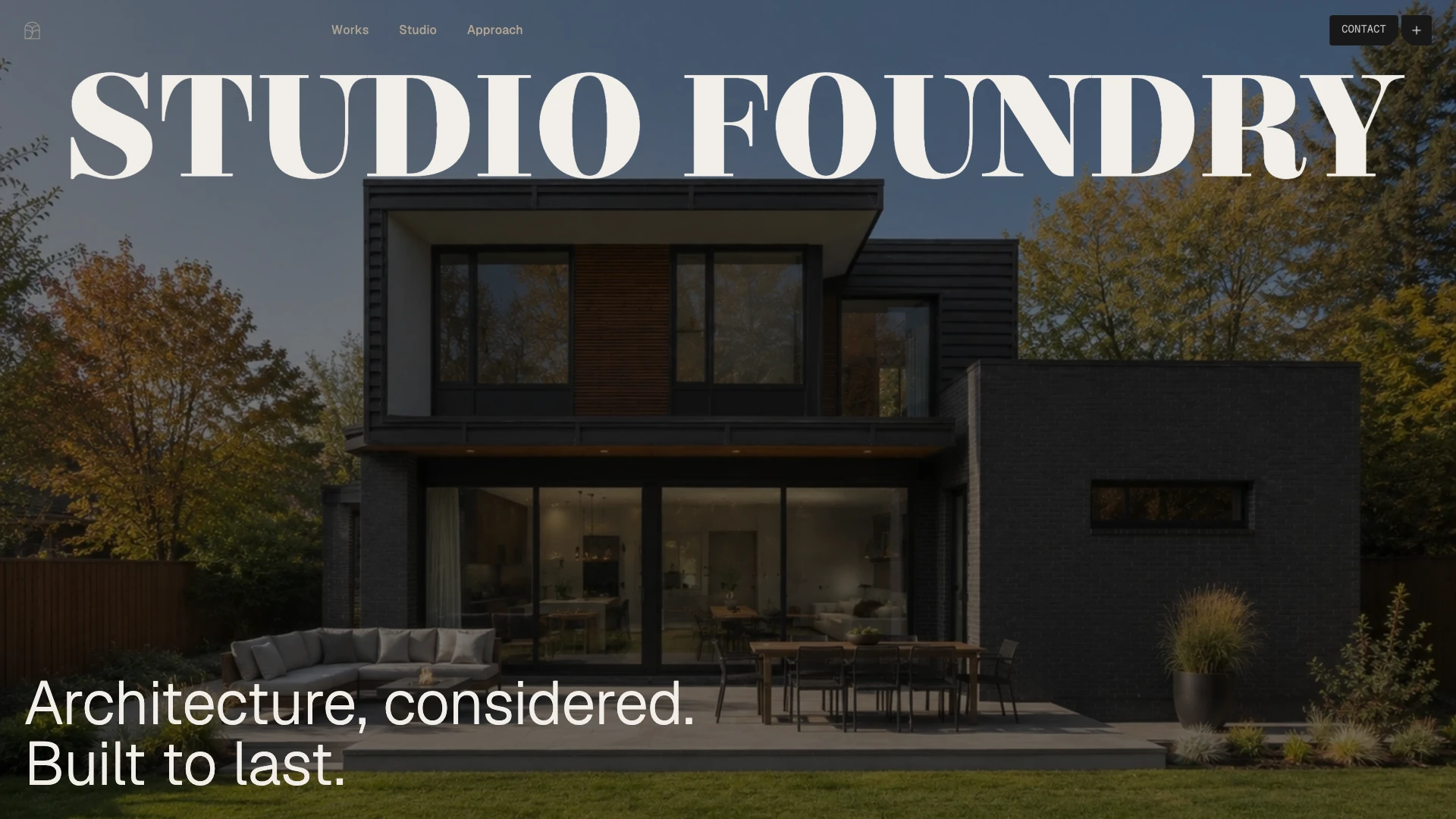
Studio projects rather than white-label engagements — but built to the same standard, and the clearest way to judge what would arrive under your brand.
( Our answers )
What studios ask first
- Will your name appear anywhere on the work?
Only if you want it to. Fully white-label, credited as a collaborator, or decided later. It’s your call, and we ask on the first email.
White-label means white-label: no badge in the footer, no link back, and nothing published in our own work section without your written say-so.
- Do you talk to our client?
Not unless you ask us to. By default everything runs through you, and your client never needs to know a second studio was involved.
Some agencies would rather we sat in the client call as part of their team, because it is faster than relaying technical answers. That works too — under your name, on your terms.
- Who owns the code at the end?
You do. The repository, the deployment configuration and the CMS setup are handed over at launch.
There is no monthly build fee and no lock-in. Take it in-house, hand it to the client, or keep us around for the technical side.
- Can you work inside our existing codebase?
Yes — that is a large part of what frontend production means here. We’re comfortable picking up a repository we did not start and matching the conventions already in it.
Tell us the stack in the first message. We work day to day in Astro, Next.js, TypeScript and Three.js, with headless content systems such as Sanity.
- How is it priced?
Fixed project fee, day rate or retainer — whichever suits how you run the engagement. The published packages on our pricing page are for businesses coming to us directly, not for agency work.
Whichever model it is, the scope and the number are agreed in writing before anything is built. If something falls outside that scope later, we price it separately and get your approval first — no surprise invoice at the end.
- How quickly can you start?
It depends on what is already in the calendar, so ask early — even a rough date holds a place better than a firm one that arrives late.
Most of the projects we run take one to four weeks once the design is settled.
Ready to hand something over?
Send the design, the stack and the date it has to be live. We will come back with what we would build, what it costs and whether we are the right studio for it.